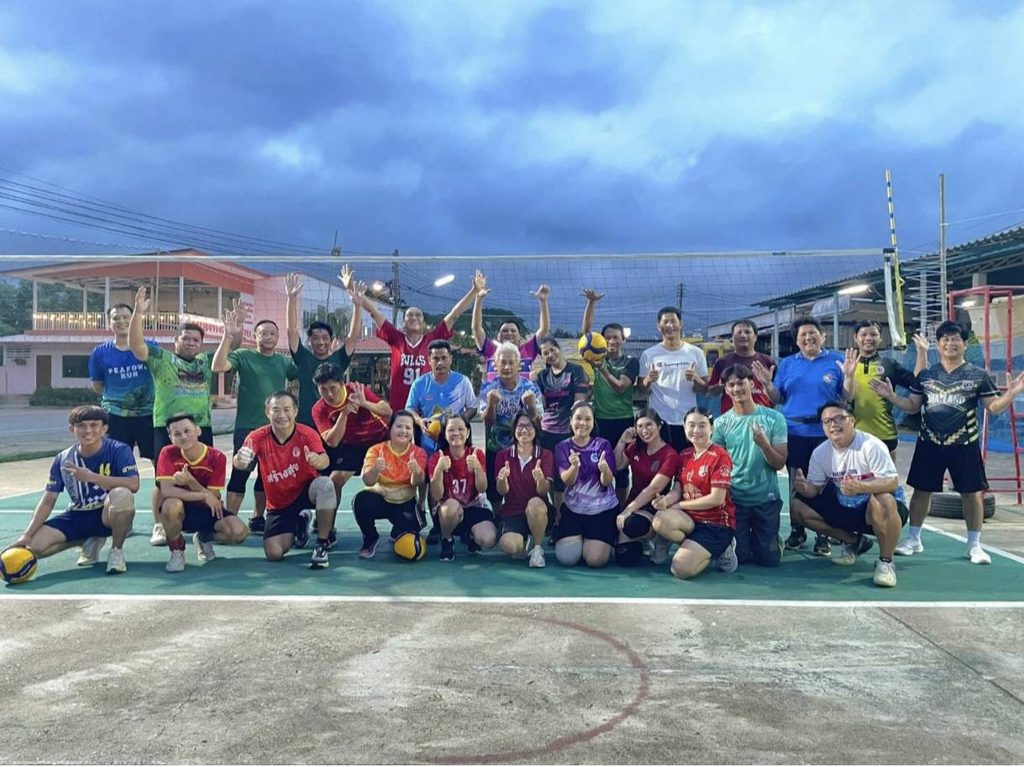
The Final Spike and Mai Pen Rai
I had never felt more pressured during a volleyball match in my life. We were completely dominated by the first two sets; my team and I could do nothing to stop them. As I heard the audience chanting, “Teacher San! Teacher San!” I looked back and saw so many parents and students waving their hands, cheering us on. I felt a wave of pressure, worried that I wouldn’t be able to fulfill their trust and hope.
The third set began, and the match grew intensely competitive. Every time I hit the ball and scored a point, our section of the audience would erupt in celebration. Whenever the opposing team scored, their supporters cheered just as loudly.
The match turned into a neck-and-neck battle. The lead kept shifting back and forth, with only a single point separating us. My team held the lead up to 22–20, but the opposing team rallied back. They reached 25, and we matched them 25–25. They scored again to make it 26–25, but we tied it up at 26–26. Right after that, one of my teammates made a service error, giving them a match point. Fortunately, my teammates and I blocked their powerful spike, leveling the score once again.
On the next play, my team had the chance to serve, but the ball unfortunately hit the net and failed to cross over, giving the opposition set point yet again. My teammate and I braced ourselves to block their spike. Luckily, we managed to block the ball and save the set. Our supporters in the crowd cheered loudly.
Next, it was my turn to serve. I felt a mix of emotions happy, excited, and nervous. I tossed the ball into the air, jumped, and hit it as hard as I could. The opposition couldn’t return it cleanly, bringing us to set point! Serving the set, I said a quick prayer in my mind. I could feel every eye in the gymnasium on me. Taking a deep breath, I served with full power. Unbelievably, the ball clipped the top of the net and dropped slowly onto the opposing team’s side. The entire crowd went wild. My teammates lifted me into the air as it was announced that we had won the fourth set.
My team showed great coordination. It was our turn to serve. My teammate served the ball, and the opposition received it and set up a spike. Our blockers jumped, but we couldn’t stop it. The opposition took a 23–22 lead. Next, they delivered a powerful serve. My teammate barely managed to dig the ball, but when our hitter spiked it, the shot was blocked. Through all this tension, my teammates kept repeating the phrase: “Mai-pen-rai… mai-pen-rai.” I didn’t understand what it meant due to the language barrier.
As the final set began, I was exhausted from four intense sets, but the audience’s expectations were higher than ever. Parents and students in our corner kept their eyes on me, shouting, “Teacher San! Teacher San!” Everyone believed we could win. The decider started, and I gave every spike of everything I had. Soon, the score was tied 22–22. Both teams were just two points away from victory and playing with extreme caution.
The opposition now led 24–22. They had a match point. Once again, my teammates looked at each other and said, “Mai-pen-rai, Mai-pen-rai.” The opposition served, we picked it up, and my teammate set the ball cleanly for me. I jumped and hit it into an open spot on the court, bringing us 23–24. Then, we served. The opposing team struggled to construct an attack and sent a free ball over. My team set it up perfectly for my spike. I jumped and hit it with all my strength, but as I came down, I accidentally touched the net, losing the point. I felt terrible and blamed myself immediately. Yet my teammates came over, smiled, and said, “Mai-pen-rai, Mai-pen-rai.”
The opposing team served again. One of my teammates dived heroically across the floor to dig the ball, scraping his elbow in the process. Once more, the ball was set up perfectly for my final attack. From the stands, I heard parents and students chanting my name again: “Teacher San! Teacher San!” I jumped, locked my eyes on the ball, and hit it with every remaining ounce of energy I had left. I thought I had scored, but my shot was blocked solid. I couldn’t believe it. I felt deep sadness, convinced that my team had lost the game because of me.
Immediately, all my teammates gathered around me, putting their arms over my shoulders and saying, “Mai-pen-rai… mai-pen-rai.” As I walked off the court, I was amazed to see parents and students waiting for me, smiling and saying, “Mai-pen-rai, Teacher San!” They told me I had played well and praised my efforts. That was the moment I truly understood what “Mai-pen-rai” meant.
Later, I learned that “Mai-pen-rai” translates to “No worries” or “It’s okay.” It made me realize why millions of people visit Thailand and fall in love with its culture. That single Thai phrase revealed a peaceful, caring, and deeply forgiving culture.
I recalled volleyball matches back home in Nepal if I had missed two critical spikes during a final match, my teammates would have been furious. Their frustration would have been obvious in their expressions and actions, and some might not have spoken to me for days. The crowd wouldn’t have been forgiving either. But my Thai teammates and supporters treated me with genuine kindness. They greeted me with warm smiles, respected my effort, and accepted my mistakes with open hearts.