
The Small Boy, the Big Language: Unlocking Hearts on the Shanghai Metro
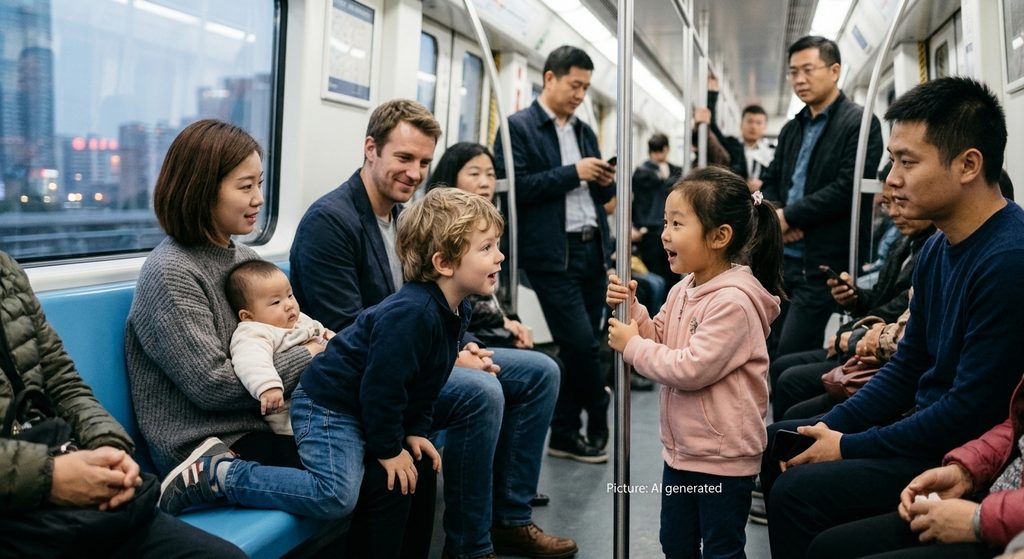
Once, I was traveling to the ancient water town outside of Shanghai. It was a journey of nearly 50 kilometers from where I was staying. I had heard many beautiful stories and seen this historic place depicted in movies, and I was eager to witness it myself.
The metro was full of people. Many were local commuters, but there were also numerous foreign visitors. A rich tapestry of languages from various countries filled the carriage as I sat near the courtesy seat. I felt lucky to have a place to sit; many people were standing, clinging to the handrails for balance.
After crossing three stations, a white child and his father entered the metro. They, too, were lucky. Moments before they entered, some passengers had left, and two seats next to me were now free. Next to where they sat, a Chinese mother was seated. She was carrying a baby in her arms, and her daughter, about 6–9 years old, was standing in front of her, holding on to the grab pole.
The white child, who seemed no more than six or seven, possessed a wide-eyed curiosity about his surroundings. Almost immediately, he looked up and asked a question in Mandarin Chinese.
The Chinese mother looked up in genuine surprise. A warm, beautiful smile instantly transformed her face, and she happily and clearly answered the boy. Hearing this small, blue-eyed child speaking fluent, native-level Chinese, the mother’s daughter began to approach him. Shyly at first, she asked him a question, and he answered confidently and naturally. All embarrassment evaporated instantly; both children were soon laughing and smiling, completely engrossed in communication.
In that moment, I truly witnessed the power of language. Seconds earlier, these two children had been strangers-products of entirely different worlds. But the moment they spoke the same tongue, they seemed like old, dear friends.
The ripple effect across the carriage was palpable. Other Chinese people began curiously looking over, their eyes filled with warmth and appreciation for the boy. I sat there as a silent witness, feeling how a language can instantaneously connect people and allow us to exchange knowledge and ideas. The mother, now deeply curious, asked the white child a few questions about himself, and the boy confidently and fluently answered her. His dad, sitting next to him, could not speak Chinese. He listened, his eyes focused on his son, a look of immense, quiet pride on his face.
Having spent my time traveling and teaching abroad, I would guess the white child was in Grade 1, perhaps six or seven years old. While he was literally small, his impact was significant. I assumed he must be living and studying somewhere in China, perhaps in an immersion setting. I wished I could understand their exact words, but I didn’t need to; I could guess and understand everything by observing their bright eyes and expressive body language.
What this journey powerfully proved is a truth we cannot deny: when children are given the right environment, they can learn any language in the world. This experience strengthened my belief in the language learning theories stating that children can achieve native-level proficiency in any language if they are immersed before the age of ten. The child was appreciated by everyone in that metro carriage. He impressed all the Chinese people, not because he was foreign, but because he showed that our hearts can easily communicate when we provide the bridge of language.
Is ‘environment’ really the golden key to language, or is it something more? Please drop your insights and observations in the comments below